Most people who buy adhesive tape buy it by category. Double-sided. Single-sided. High tack. Low tack. They scan a product sheet, match a format to a rough description of the job, and place an order.
That works well enough, right up to the moment it doesn’t.
The splice fails at 400 meters per minute. The carry handle pulls away from the corrugated box on the third day of transit. The tape used on a cold-storage line loses adhesion below 4°C. None of these failures show up in the product category. They show up on the production floor, in a customer complaint, or in a returns report.
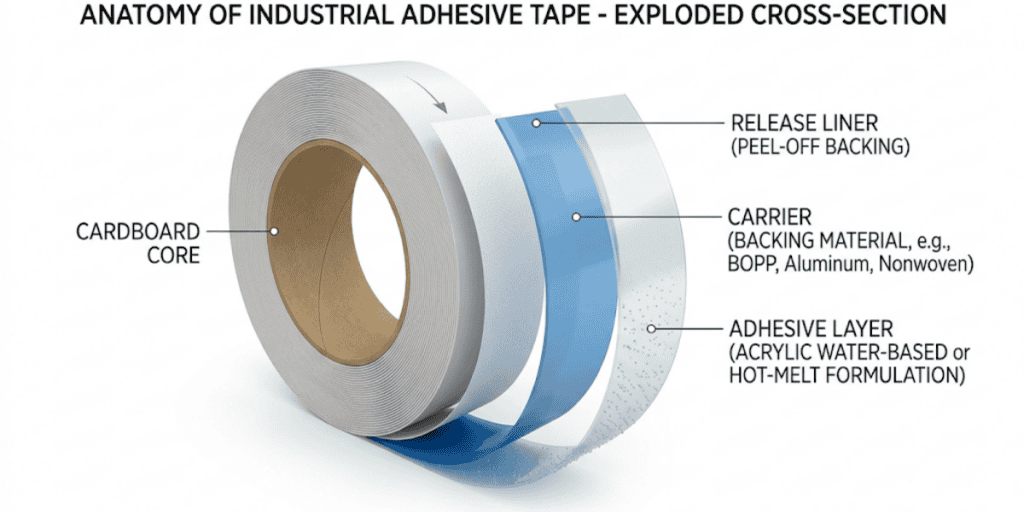
The gap between “tape that matches a description” and “tape that works in a specific application” comes down to three things: the carrier, the adhesive chemistry, and the construction. Each one is a decision, not a default. And each decision only makes sense when the application is defined first.
This article opens the roll and explains what’s actually inside a high-performance industrial adhesive tape, why every layer is a deliberate choice, and what questions any serious buyer should be asking before selecting a tape for a critical application.
The Commodity Assumption and Where It Breaks Down
The adhesive tapes market is large and growing. Global market research published in 2025 places the specialty adhesive tape segment alone at over $41 billion, with sustained growth through the decade ahead driven by industrial manufacturing, packaging automation, and electronics. Yet despite that scale, most procurement decisions in industrial settings still treat tape as a low-stakes commodity purchase.
That assumption holds in applications where the stakes are genuinely low: masking, light bundling, temporary marking. But in automated manufacturing environments, the tape is part of the process. It runs on a machine. It interacts with substrates that have specific surface energies. It operates at temperatures, speeds, and tension levels that a general-purpose product was never engineered to handle.
When tape fails in those environments, the cost is never the cost of the tape. It is the cost of downtime, scrap, rework, and in some cases, product that reaches the end customer in a compromised state.
The solution is not to find a more expensive commodity tape. It is to stop treating tape as a commodity.

Layer One: The Carrier
The carrier is the backbone of any adhesive tape. It is the material that holds the adhesive, gives the tape its physical form, and delivers a specific set of mechanical properties to the application.
Carrier selection is where application requirements translate directly into material choices. A few examples from real industrial use cases illustrate the logic:
Aluminum foil is electrically conductive and detectable by metal detection systems. In hygiene manufacturing, where splice detection is a quality requirement rather than an optional feature, an aluminum carrier is not a preference. It is a specification driven by the downstream detection equipment on the production line. Davik’s DS4935 splice detection tape is built on an aluminum foil carrier for exactly this reason: the line requires it.
BOPP film (biaxially oriented polypropylene) offers high tensile strength and dimensional stability. On wide-web production lines running at high speeds, dimensional stability under tension matters. DT4133, Davik’s splice detection tape for wide hygiene lines, uses a BOPP film base, which supports the aggressive bonding performance the format demands without distorting under machine processing forces.
Aluminum-PET laminate combines the detection properties of aluminum with the dimensional rigidity and strength of PET film. DS49925 uses this laminated construction to serve textured nonwoven surfaces where a single-material carrier would either sacrifice detection reliability or conformability. The laminate solves both requirements in one structure.
Nonwoven fabric carriers introduce stretchability that film and foil carriers cannot provide. DS4885, Davik’s most specialized splice detection tape, is built on a nonwoven base precisely because the application requires it: high-speed, wide lines where dynamic tension fluctuations would create stress concentration points in a rigid carrier. The nonwoven absorbs and distributes those forces.
None of these choices are interchangeable. Each one exists because a specific application requirement made it the correct answer.
Beyond hygiene manufacturing, the same carrier logic applies across Davik’s product range. Carry handle tapes designed for food and beverage packaging use carriers engineered for the dimensional consistency that automated application lines require. Freezer tapes are built on carrier materials selected for performance in low-temperature environments where standard carriers become brittle or lose dimensional integrity. The starting point is always the condition of use.
Layer Two: The Adhesive Chemistry
The adhesive is what creates the bond, and adhesive chemistry is where most tape failures originate.
In Davik, there are two adhesive technologies in industrial tape manufacturing: acrylic water-based adhesives and hot-melt adhesives. Each has a defined performance profile, and neither is universally superior.
Acrylic water-based adhesives cure to a stable bond and offer strong aging characteristics. They resist temperature variation across a broad range, perform reliably under long-term stress, and carry a lower risk of adhesive bleed or transfer. In applications where the tape is processed through subsequent manufacturing stages, including folding machines, printing lines, or lamination equipment, adhesive bleed creates quality and contamination problems. Water-based acrylic formulations minimize that risk. DS4935, DS49925, and DS4885 all use acrylic water-based adhesive for this reason.
Hot-melt adhesives deliver aggressive initial tack. They bond instantly on contact, which is the defining requirement in flying splice operations on wide, high-speed lines where the adhesive has a fraction of a second to form a bond as the new roll meets the running web. DT4133 uses a hot-melt formulation because the application demands immediate grab, not long-term aging stability.
The wrong chemistry produces predictable failures. A hot-melt adhesive selected for a post-processing application because of its aggressive tack will bleed under machine heat and contaminate downstream equipment. A water-based acrylic selected for an instant-bond flying splice application because of its aging characteristics will fail to grab before the splice point passes through.
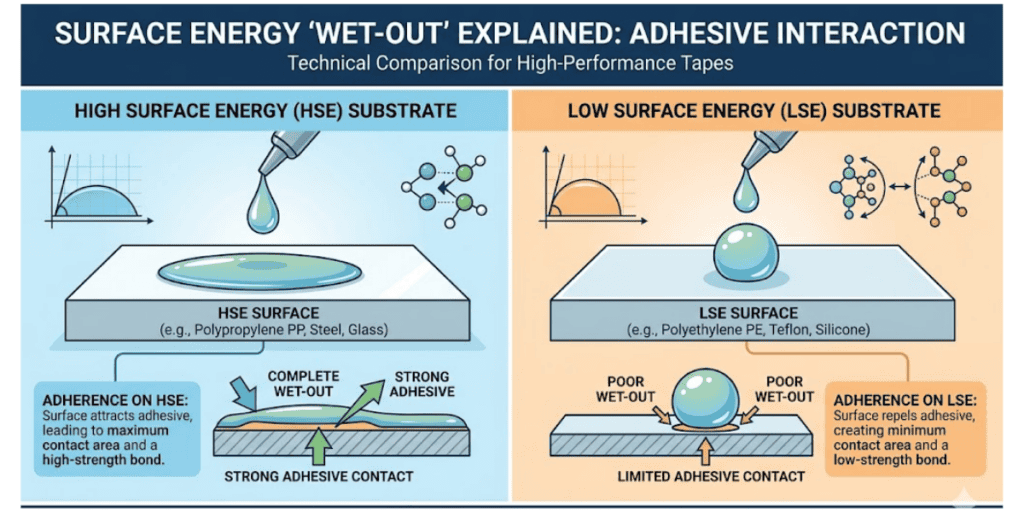
Adhesive chemistry is also where surface compatibility matters most. Different substrates have different surface energies. Low-energy surfaces, including many polyethylene and polypropylene films, require adhesive formulations specifically engineered to wet out and bond to those surfaces. Standard adhesives may appear to bond on initial application and then fail under stress or time because the surface energy mismatch was never addressed.
This is the variable most buyers never ask about. Asking your tape supplier what surface the adhesive was formulated for is one of the most productive questions in tape specification.
Layer Three: The Construction
Construction refers to how the carrier and adhesive are combined and whether additional functional elements are incorporated into the tape structure.
Single-layer construction, one carrier coated with adhesive on one or both sides, is the most common format. But functional requirements frequently demand more.
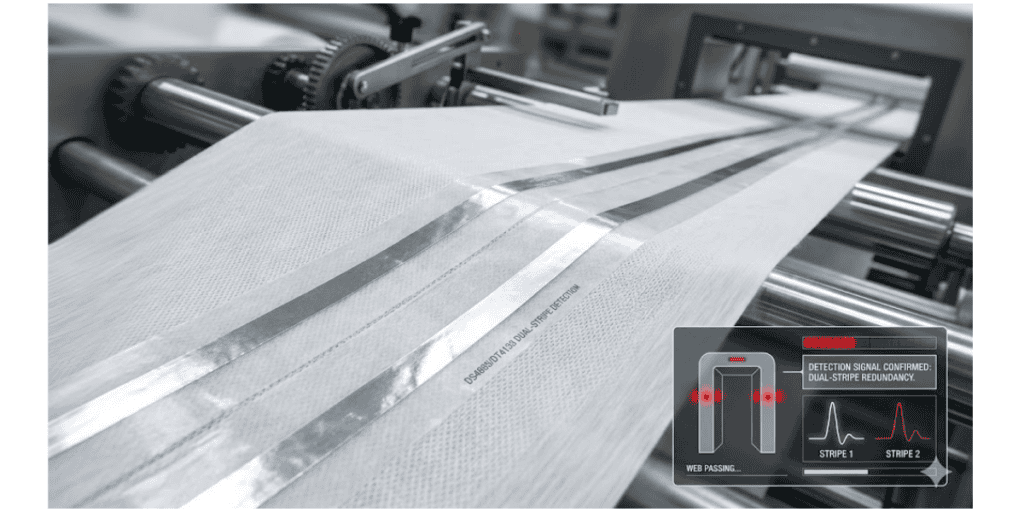
In Davik’s splice detection tapes, aluminum stripes are integrated into the construction to serve a specific purpose: triggering metal detectors on hygiene production lines. DS4885 and DT4133 both incorporate two aluminum stripes rather than one, providing redundant detection capability at the widths and speeds those tapes are designed for. The dual-stripe configuration is a construction decision made because single-stripe reliability was insufficient for the detection requirement.
Laminated constructions, like the aluminum-PET structure in DS49925, exist because no single material offers the full combination of properties the application requires. The lamination is not an added cost. It is an engineering decision that makes the tape function.
In carry handle tape, the construction incorporates the pre-laminated spool format that eliminates the need for field lamination during application. That construction choice exists because the manufacturing environments that use carry handle tape require application accuracy and process stability that a non-pre-laminated format cannot deliver reliably at production speeds.
The thickness specification also falls under construction. DS4935 has a total thickness of 85 microns, with a 30-micron film and adhesive layers delivering the balance. That specification is not arbitrary. It is determined by the mechanical requirements of the application and the clearances within the equipment the tape runs through.
The Questions a Serious Buyer Should Ask
If you are selecting adhesive tape for an industrial or automated application, the following questions will tell you more about whether a tape will perform than any product sheet:
What surface does this tape bond to, and what is the surface energy of that material? Adhesive formulations are matched to surface types. Confirming the match before purchase eliminates a common failure mode.
At what temperature will this tape be applied and used? Both the application temperature and the end-use temperature affect adhesive performance. A tape specified for ambient conditions may fail in a cold-storage or high-heat environment.
How much mechanical stress will the tape experience after application? Tension, flexing, shear force, and peel force are different stress types. The construction and adhesive chemistry need to match the dominant stress type in the application.
Does the application require detectability? In food and beverage manufacturing or hygiene product manufacturing, tape used in a process that involves detection systems needs to be engineered for detection. This is a carrier and construction specification, not a coincidence.
What line speed and dwell time are available during application? In automated environments, the time available for a bond to form is fixed by the machine. Aggressive initial tack, a hot-melt characteristic, exists because some applications give the adhesive less than a second to grab.
What happens to the tape after application? If the tape passes through heat, folding, printing, or further lamination, the adhesive needs to remain stable through those processes. Bleed, transfer, and delamination are construction failures with origins in the specification stage.

Why Application-First Development Produces Different Results
The product-first approach to tape development starts with a formulation and describes the applications it suits. The application-first approach starts with the application and builds the tape around it.
Davik has followed the application-first model for over 40 years. The in-house R&D team includes chemists, material engineers, mechanical engineers, and production specialists. When a customer brings a new requirement, the process moves through six defined stages: understanding the customer’s need, analyzing options with the R&D team and production experts, selecting the most practical solution, running a sample production, collecting customer feedback, and adjusting based on that feedback before finalizing the product. The process is structured, not informal, and the company holds ISO 9001:2015 certification across its operations.
That structure matters because tape development problems are rarely simple. The carrier, the adhesive chemistry, and the construction each interact. A change to one variable changes the behavior of the others. Having chemists, engineers, and production specialists working together on the same problem, against a defined customer requirement, is what makes it possible to arrive at a tape that performs reliably rather than one that performs acceptably.
Davik was among the first manufacturers globally to produce printable tapes and carry handle tapes, both of which have since become established product categories. That track record reflects what consistent application-first development produces over time: products that address real operational needs before the broader market recognizes them as standard requirements.
The splice detection tape range, the carry handle tape portfolio, the resealable fingerlift tapes, the low-tack solutions, and the cold-storage tape line each represent a response to a defined set of application requirements rather than extensions of a general product format. For buyers operating automated lines, this distinction is the difference between a tape that is specified and a tape that performs.
Frequently Asked Questions
What is the difference between a commodity adhesive tape and an application-specific industrial tape?
A commodity tape is designed to perform adequately across a broad range of general uses. An application-specific industrial tape is engineered around defined requirements: the substrate it bonds to, the conditions it operates under, and the mechanical stresses it will experience. The carrier, adhesive chemistry, and construction are each selected to match those requirements.
Why does adhesive chemistry matter in industrial tape selection?
Adhesive chemistry determines how a tape bonds, how that bond holds over time, and how the tape behaves when exposed to heat, cold, or processing equipment. Using an adhesive formulated for one set of conditions in a different application produces predictable failures, including bleed, delamination, and bond failure under stress.
What is the role of the carrier in tape performance?
The carrier gives the tape its mechanical properties: tensile strength, stretchability, dimensional stability, and in some cases, functional properties like metal detectability. Carrier selection is one of the most consequential decisions in tape development because it determines which applications the tape can physically serve.
How do I know if my current tape is the right one for my application?
If your tape was selected by category rather than by application requirement, there is a reasonable chance it is not optimized. The indicator is usually a recurring failure: splice breaks at a consistent point in the process, carry handles failing under specific conditions, or adhesion problems at predictable temperatures. Each of those points to a specification mismatch between the tape and the application.
Does Davik develop custom tape solutions?
Yes. Davik’s in-house R&D team, which includes chemists, material engineers, mechanical engineers, and production specialists, works directly with customers on application-specific development. The process starts with understanding the customer’s requirement in detail, moves through solution analysis and evaluation, and includes a sample production run with a feedback and adjustment stage before the product is finalized. Customers with requirements that fall outside standard product configurations can contact Davik to begin that process.
What industries does Davik’s industrial tape range serve?
Davik’s tape portfolio covers hygiene manufacturing (nonwoven and film web splicing), food and beverage packaging (carry handle tape, resealable fingerlift tape), cold-storage applications (freezer tape), and general industrial uses including low-tack surface protection and printable tape formats.
